
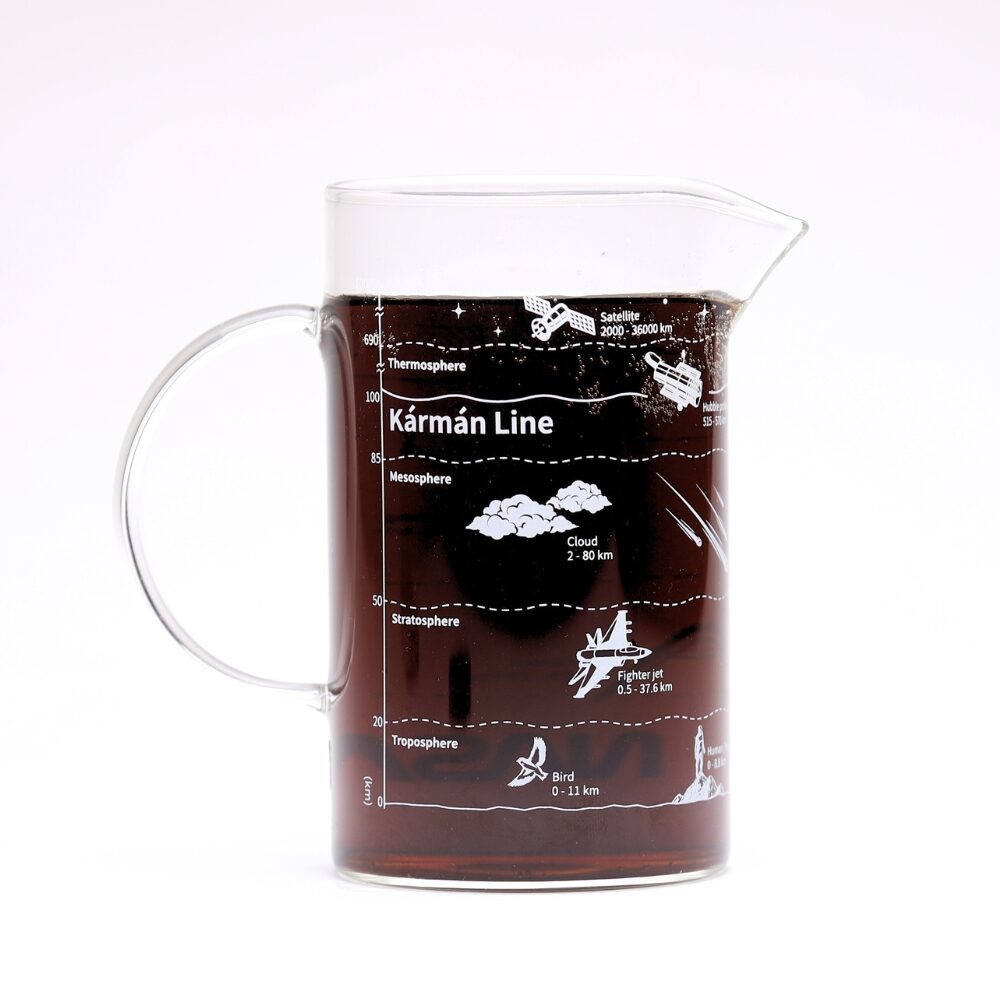
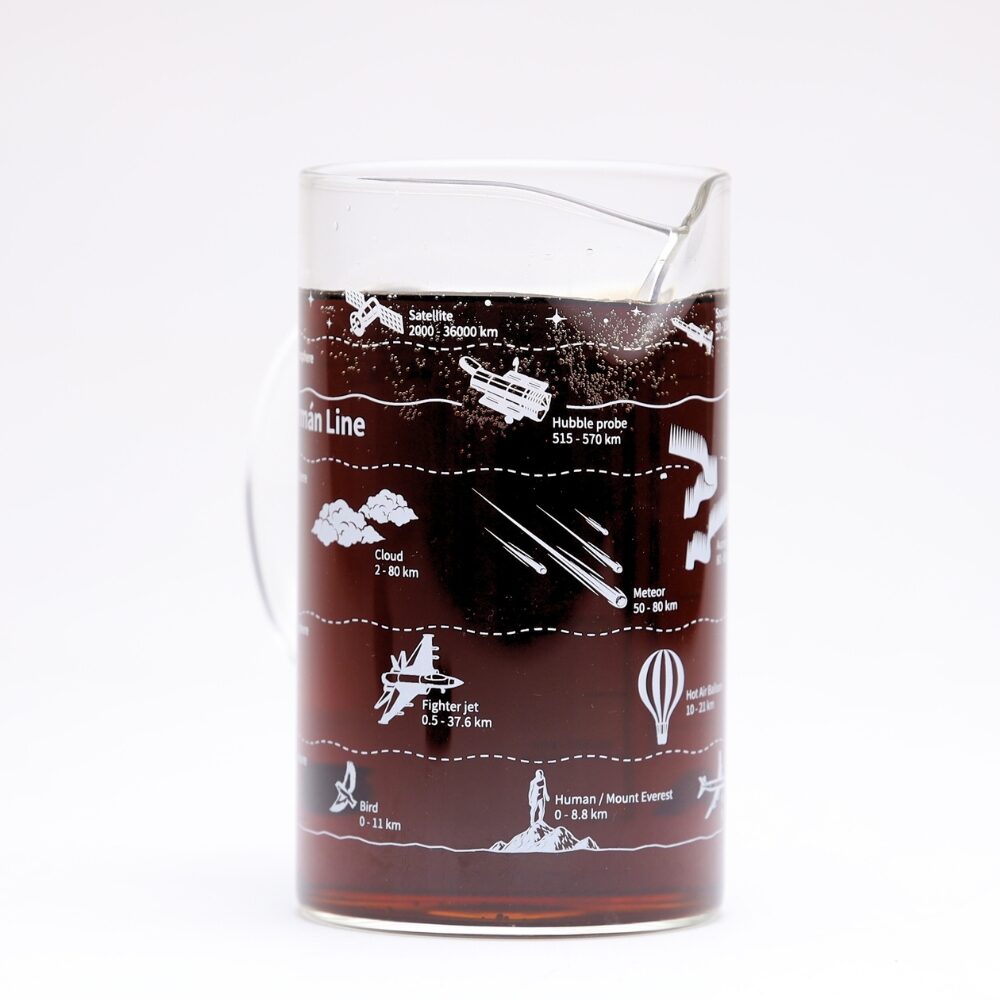
NASA Kármán Line Atmosphere form beaker with handle

NASA Nebula Heat-Sensitive Mug
$17.00

NASA Cosmic Fluid Spinning Cup – Earth (Blue) / Planet GJ 504b (Pink)
$30.00
$20.00
Inspired by the altitude of the Kármán Line, this transparent, heat-resistant glass beaker features precise measurements, offering a professional scientific atmosphere. Perfect for tea, coffee, or laboratory use.
Mr. Sci Science Factory — Cross the boundary of the atmosphere and enjoy space-inspired living!
Product Specifications:
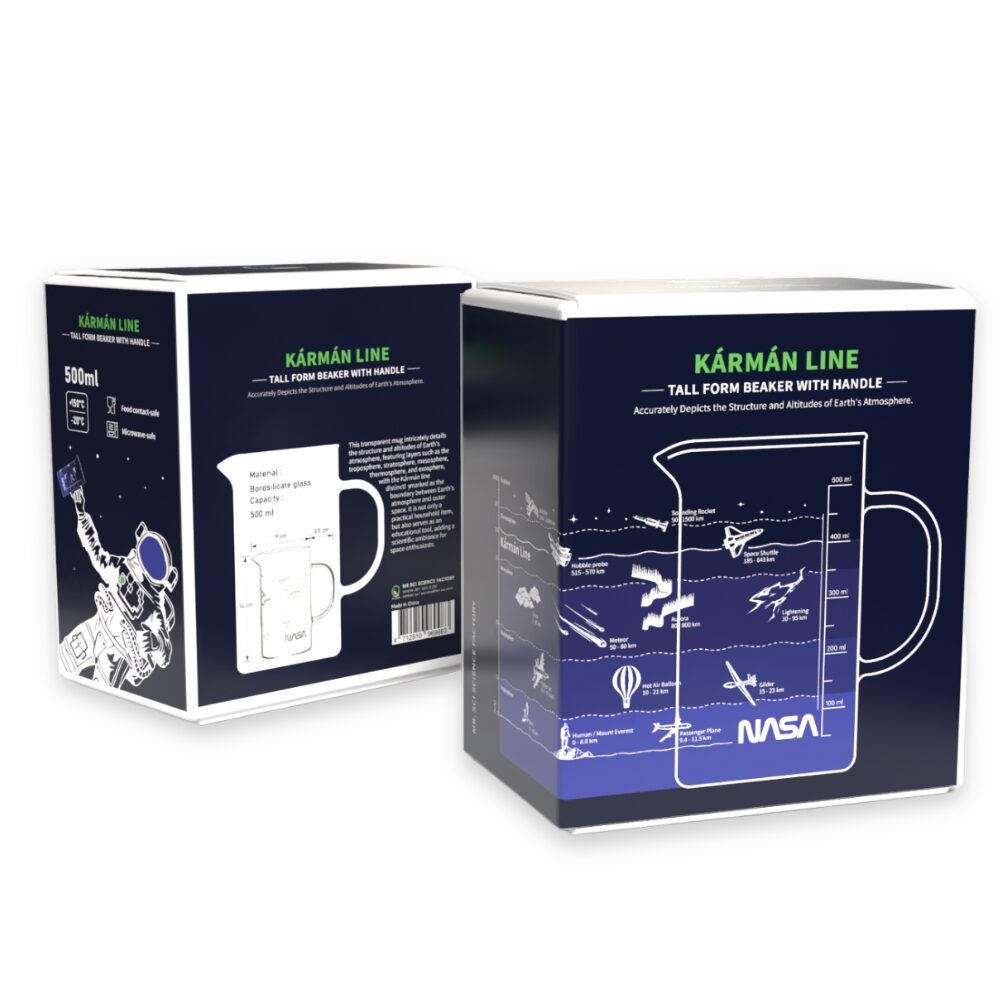
► Beaker size & capacity: Diameter 8 cm (14 cm with handle), Height 14 cm / 500 ml
► Material: High borosilicate heat-resistant glass
► Made in: China / Designed in Taiwan
Notes:
► Handle with care to avoid damage.
► Can withstand high temperatures of 150–200°C.
► Measurement marks may have ±5 ml deviation, which is normal.
► Dishwasher safe / Microwave safe.
Description
“To infinity and beyond!” — But do you know where space actually begins?
At what altitude can we truly say: “You are officially in space!”
Is it just the highest point a plane can fly, or must it be higher?
This is where the Kármán Line comes in.
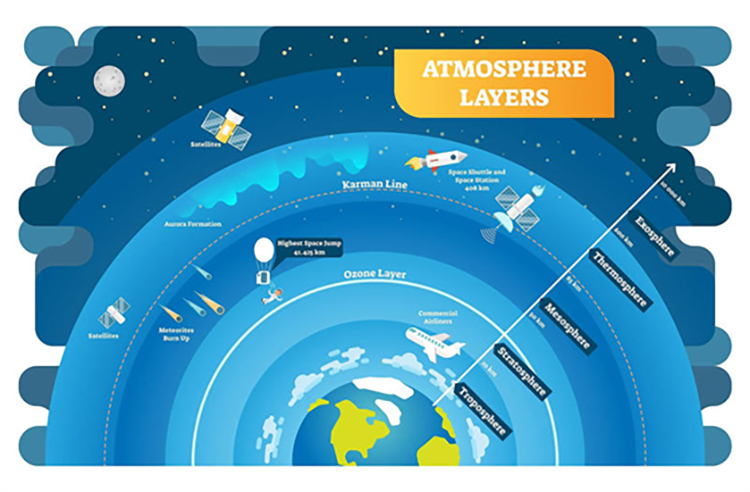
What is the Kármán Line?
Scientists have long debated where the “edge of the atmosphere” lies.
The International Aeronautical Federation (FAI) set a standard at an altitude of 100 km, called the Kármán Line—the boundary between Earth’s atmosphere and outer space.
Above this line, the air becomes extremely thin, making it impossible for planes to generate lift with wings. Rockets, relying on onboard propulsion, are needed to ascend further.
In other words, this is the limit for airplanes and the starting point for rockets.
The line is named after aerospace engineer Theodore von Kármán, who in 1963 found that above 100 km, air is too thin for aerodynamic flight, requiring orbital mechanics to continue ascending.
Since then, 100 km has been recognized as the official boundary between the atmosphere and space, marking the beginning of spaceflight.
Is the Kármán Line exactly at 100 km?
Not entirely! The Kármán Line is a conceptual boundary, roughly between 85–100 km.
-
100 km (common definition): Most widely used; recognized by NASA and major space agencies as the start of space. Above this height, air pressure is extremely low, and spacecraft no longer rely on aerodynamic lift.
-
80 km (Kármán’s 1956 calculation): Theodore von Kármán calculated that at around 83.6 km, the air is too thin to support conventional flight, and movement depends more on inertia or gravity. This has physical significance, but 100 km is more broadly accepted.
It also roughly corresponds to the bottom of the thermosphere in Earth’s atmospheric structure.
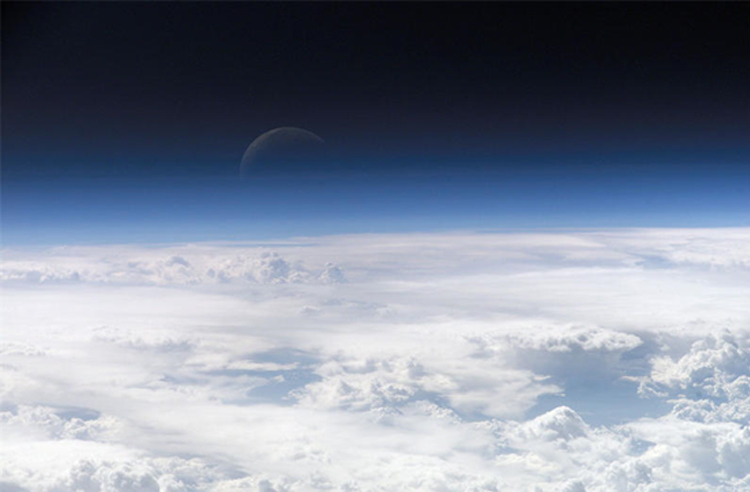
(At this altitude, you can actually see the curvature of the Earth!)
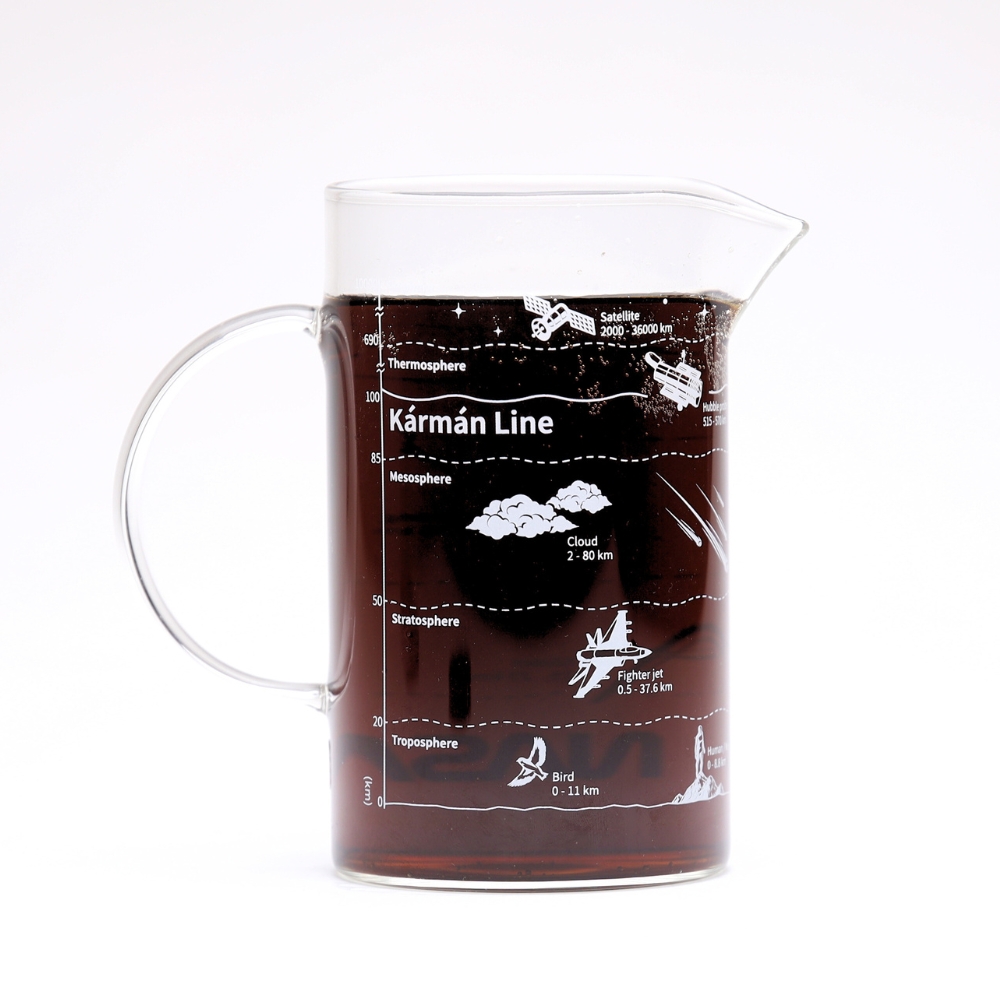
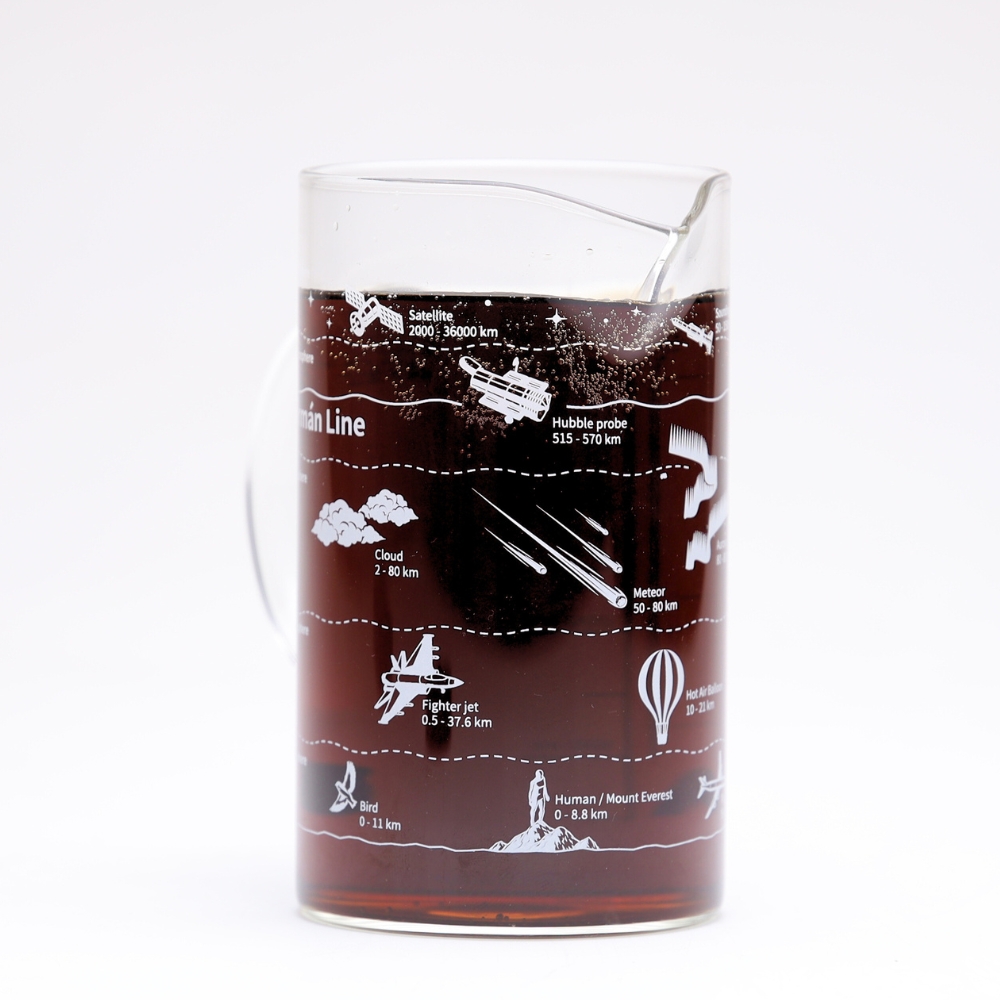
Layers of the Atmosphere Design
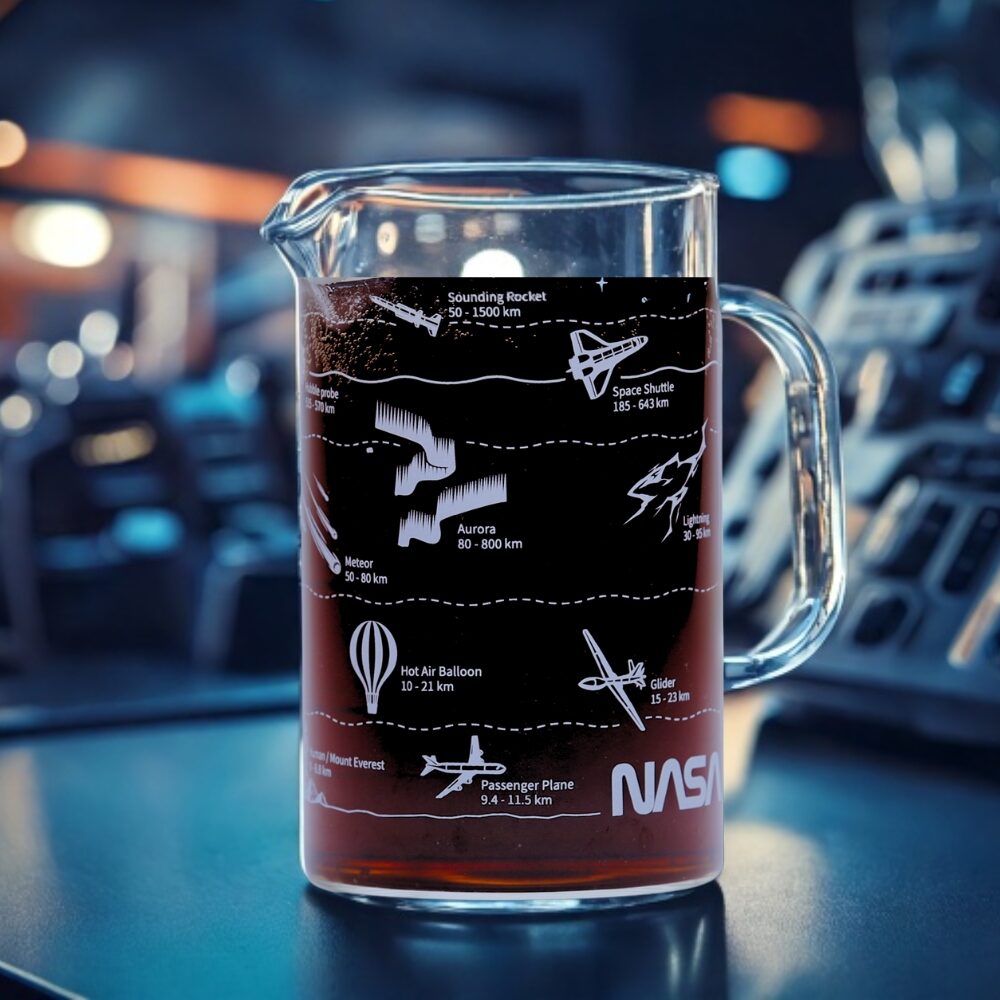
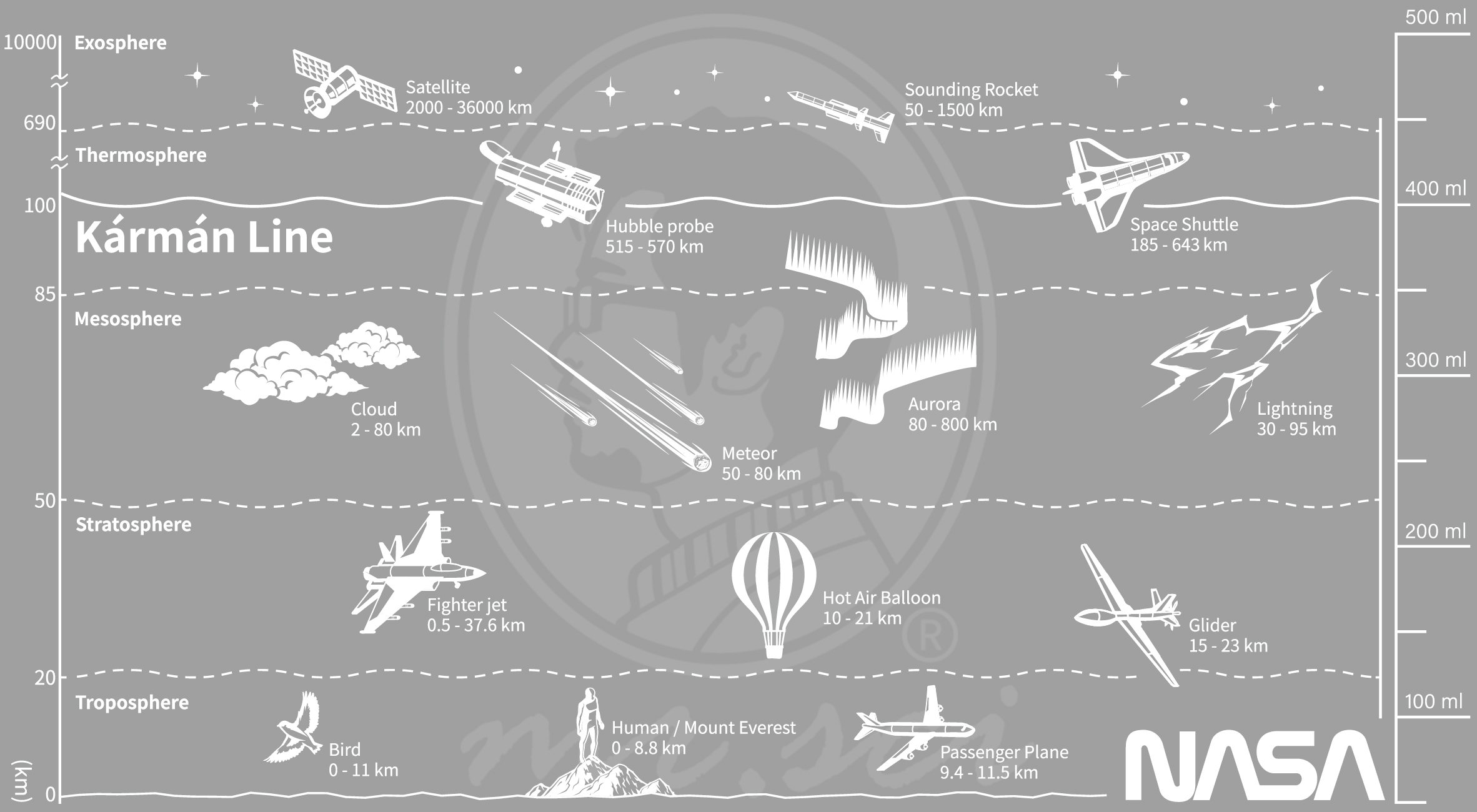
On the left side of the beaker, the height in km is marked clearly, showing each layer of Earth’s atmosphere:
-
Troposphere
-
Stratosphere
-
Mesosphere
-
Thermosphere
-
Exosphere
The Kármán Line is highlighted, along with the corresponding flying objects (commercial planes, hot air balloons, military reconnaissance aircraft, spacecraft) and natural phenomena (meteors, auroras, lightning).
Above the Kármán Line, sparkling stars and satellites are illustrated.
On the right side, the beaker capacity is marked up to 500 ml, with 50 ml increments—perfect for drinks, milk, hand-brewed coffee, cocktails, cooking, or baking.
Design Concept by Mr. Sci Science Factory
The layered structure of Earth’s atmosphere is integrated into the beaker design, letting you feel the vastness and mystery of the universe while enjoying coffee or tea.
By using liquids of different densities, you can create visually stunning layered drinks—like a miniature experiment in space!
Inspired by the Kármán Line: The boundary between Earth’s atmosphere and space, ~100 km altitude, symbolizing the start of human space exploration.
-
Heat-resistant glass can handle hot and cold beverages.
-
Transparent body shows the color and layers of your drink.
A must-have for sci-fi and aerospace enthusiasts!
Usage:
Laboratory / Classroom: Ideal container for science experiments or demonstrations
☕ Office: Professional mug for coffee or tea, adding fun to work
Gift for science enthusiasts: Perfect for birthdays, holidays, or gift exchanges
Home collectible: Combines aesthetics with scientific spirit